in a nod to the virus that has been lodged in my throat since thanksgiving day, this week's entry is for one of my favorites pieces of seventies science fiction, robert wise's the andromeda strain (1971).
11.30.2010


11.27.2010
those satisfactions are permanent
thanksgiving day turned out to be kind of a peculiar, solitary affair this year. i was a little under the weather and, as a result, only ventured out of the house for food. the rest of the day i spent with mystery science theater 3000 weirdly bookending the movie i wanted to talk about here today, monte hellman's two-lane blacktop (1971).

i ran this on a loop all afternoon and, in retrospect, it seems the perfect way to see this film, as it left me with that distinct hum in my head that you only get when you've been on the road for a long time, like i was still in motion but no longer had a destination. it is beautiful and confounding that way.

it was the only major studio full-length feature that hellman ever made (i love the universal logo with nothing but engine sounds over it) after about a decade and a half in roger corman's boot camp. it remains one of my favorite efforts of the last golden age of american filmmaking. there is no love lost between me and easy rider (1969), i think it's silly and ham-handed, but i owe it a debt of gratitude, nonetheless, because without its success we never would have had this movie or others like it. a seismic shift happened in the wake of easy rider that resulted in a cultural climate where something like two-lane blacktop could be the single most anticipated film of the year. no less than esquire magazine touted it to be to the movie of the year while it was still in post-production. they even went as far as to print the entire screenplay in the magazine.

unheard of. try this at any mainstream magazine with a circulation like esquire's today and it would be considered downright commercial suicide. this golden age couldn't last forever, obviously, but there was a glorious window of about five years where a guy like monte hellman could get a major studio budget and final cut to make an austere road movie with a cast of almost exclusively non-actors. throw in the attendant publicity from esquire and the like and it must have seemed like the possibilities were nearly limitless.

the film relates the story of four people whose lives intersect as they traverse the nation's highways. identified in the credits simply as the driver, the mechanic, the girl and GTO, they move through the middle american landscape like ghosts, rootless and grim. the driver and the mechanic (james taylor and dennis wilson in their only film roles) move from town to town racing their '55 chevy against local talent to pick up enough cash just to get to the next place. the girl (laurie bird) sneaks into their car while they are in a diner and they continue to move down the road as if she's been there all along. GTO (vitagraph favorite, warren oates) is identified solely by the car he drives because, as the stories he tells to a series of hitchhikers demonstrate, he has no identity of his own that he cares to keep. these four ciphers convene at a gas station eventually and a race across the country, with pink slips as the prize, is proposed. racing enthusiasts, turn it off now. if you came to see nitro burning dragstrip action, you are in the wrong place. that's not what it's about.

in fact, i can't tell you what it's about and that's the beauty of it. it is, in every way, a vessel. it is going to be about something completely different for you when you watch it, and i hope you do. the best i can do is tell you what it made me think about.
it made me think about the irreconcilable and the inextricable. you have the grim, mostly silent driver and mechanic and their machine. their '55 chevy is cruelly efficient, lovingly maintained, primer gray, nothing unnecessary, nothing to weigh it down come race time. it exists solely to perform its function. it is beautiful in its purity. at one critical juncture, the mechanic has the driver pull over to deliver some news, as if he doesn't want to interrupt the constant conversation they are implicitly having with the car. GTO's namesake car is flash, conspicuous consumption, delivered from an assembly line. he can cite reams of statistics and specifications, all gleaned from sales brochures and owner's manuals. he never stops talking long enough to listen to it. each serves to illustrate the defining characteristics in the other in high relief. GTO's incessant insecure blather highlights the gravely meditative interplay between driver and mechanic. the joyless, almost ascetic way the driver and mechanic approach racing, and what little else they do, underscores GTO's understanding that there is more to be had from this life, whether he knows how to achieve it or not. the girl is on a different trajectory altogether and cannot/doesn't care to, ultimately, move any of the three from their respective orbits. we only truly understand these characters in relation to their opposite number. they wouldn't fully exist without each other as foils. at least, we wouldn't have as full a grasp of them. they do have one thing in common. they are all points on a spectrum of yearning, of loneliness, but their brief interaction does nothing to alleviate it. it only exacerbates it, each pushing off of the other, moving faster and farther away in reaction to their brief contact. they are more real for the encounter, but no less alone.

it made me think about my dad's america, the things he was able to see and do. i was born just before this was made but he was a young man, living this moment. he was a quiet guy but there was an active mind behind that. there had to be a restlessness, as a result. i'm pretty sure it's where i get it from. so, it's easy to picture him out there, always moving. he traveled back and forth across this country a good deal as a young man and it makes me wonder what he thought about while he watched it go by his window, if it seemed to him like the last gasp of a certain type of american dream. it makes me wonder if it is ever possible to know these things as they are happening or if they are only available to you in retrospect. it makes me wonder if he's why i like to drive so much. the car will always be best refuge for people like us. as the frontier disappears, we always have the lure of horizon, even if it's just the dashboard. we take our frontier with us.

and it made me think of the tragedy in wisdom that brings no profit to the wise. at the end of the film, GTO is relating his final story to the last set of hitchhikers he has picked up. he tells them about winning his car from a couple of street racing punks, claiming he defeated them in a cross-country race by three hours in his '55 chevy. he has appropriated the story of the driver and mechanic for his own, extolling the virtues of their monastery on wheels versus one of these detroit machines. the recognition of just what he is and how far it is from what he wants is palpable when he tells the soldiers he picked up that "those satisfactions are permanent". it's one of the most devastatingly sad lines i have ever heard uttered onscreen.

i highly recommend it, obviously. hellman's frame compositions are painterly. the landscape is open but not void and the colors are beautiful. the amateurs in the cast are awkwardly real. oates is brilliant, as always. it's a glimpse of something we'll never see again, so take full advantage of it. if you do see it, let me know what you think. i'd like to hear what you found in it.
11.23.2010
starlite cinema series - silent night
starlite cinema makes a triumphant return to the smiths' abode in december with a twist on a holiday theme - silent night.

we are going to take advantage of this year's bevy of notable silent film restorations and show you two of the best of the lot. first up will be buster keaton's sherlock jr. (1924).

buster plays a lovelorn projectionist/amateur sleuth who is competing for the object of his affection with a conniving scoundrel who frames him for stealing the young lady's father's watch. dejected, he retreats to the sanctuary of the projection booth. our hero then falls asleep and dreams himself right into the melodrama happening on the screen. from that point, it is filled with daring and imaginative sights. as always, keaton does his own elaborate stunts, all in real time. this film is a perfect link between the non-stop gags of his two-reelers and the more plot driven features like the general (1927). it is my favorite silent comedy ever made and an enduring testament to the power of movies to spark our imaginations.
our feature presentation will be the new, complete restoration of fritz lang's metropolis (1927).

there really aren't the words to tell you how beautiful i think this film is. there are some shots in it that just make my heart ache to live in that vision of the future, ultimately dystopian or not. the particular version we will be showing has twenty-five minutes of footage in it that had been though lost for the last eight decades. in 2008, a museum curator in buenos aires discovered a 16mm negative that contained the lost footage and, in conjunction with the murnau foundation, went to work putting together the most complete version of the film anyone has seen since its premiere in berlin. it changed the face of film. come see it as fritz lang intended for the first time.
there may be one or two other, more christmas-oriented surprises, if you've been good. if not? cole in your stocking! hey-o!
the screening will take place on friday, 12.17.10 at 7 p.m. here is the facebook event page. as always, if you're not facebook-equipped and you would like to attend, just send me a message and i will make sure you get all the pertinent details. i can't wait for this one. hope to see you there.
p.s. kino international is the fine company responsible for both of these sterling releases. no other company can touch them when it comes to the quality and quantity of significant silent film holdings they have. if you are of a fan of silent cinema and you somehow don't already know their work, your whole world is about to change.
11.21.2010
thanksgiving by starlite
november's edition of starlite cinema is now history, and a great evening it was.

our double feature tonight was a charlie brown thanksgiving (1973) and big night (1996). it was a beautiful night with old friends and new in a lovely new venue, courtesy of lauren and stephen smith. the smiths went above and beyond for starlite, stuffing us all to the gills with a dinner that had thematic ties to both films tonight.

sometimes the spaghetti likes to be alone.
there was a pumpkin pie that was promptly devoured. lauren made s'mores by blowtorch! and the bruschetta was a work of art.
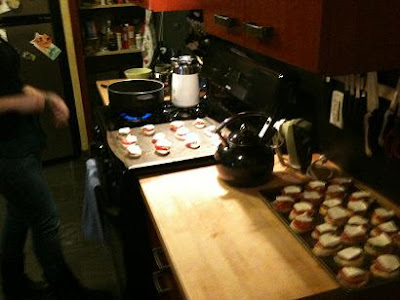
it all added up to a lovely celebration of film and food with my austin family. i wish everyone could have been there.
some things vitagraph is thankful for right about now:
the annie street arts collective - this would have never started without them. i am privileged to know a group of such imaginative, caring and endlessly entertaining people. i am proud and happy to call them my friends and i appreciate them helping me get this series rolling more than i can ever say.
lauren and stephen smith - i can't thank you guys enough for the wonderful food and hospitality tonight. you added a touch of home that was indispensable, especially appropriate for thanksgiving. i can't tell you how much i am already looking forward to the next time.
my friends that come to these screenings - i am grateful that you come out and share these evenings with me. i am glad you trust that i am going to show you something worth your time and energy. it's nice to discover new things and re-examine old favorites in your fine company.
my friends that don't - i am glad you meet me here, virtually, and listen while i prattle on about how much i love the movies. thanks for indulging me and thanks for participating in the discussion.
late autumn in texas - in august, these screenings can be murder. right now, though, it is damn near perfect. i can't think of a much better setting for this than a cozy night under a (nearly) blue moon with the wind rustling through the dry leaves.
the movies - a whole world of cinema is out there. in the months to come we are going to try and take advantage of all the places it can take us. i hope you find time to come along with us a time or two.
and now, charles durning will lead us in the invocation...
i'll be back soon with details about the december installment. happy thanksgiving, everyone!
11.19.2010
the tramp's last stand
when it comes to silent film comedians, one debate will continue eternally - charlie chaplin versus buster keaton. chaplin, to me, is the beatles of this argument. virtuosic, precise, total. he also has that blasted sentimental streak. keaton, the rolling stones. he gets by - ahead, even - more on guts and guile. he's no slouch in the talent department either, he's just more about the heart than the head. he certainly was much more blues than tin pan alley. it may be stating the obvious, but i am an unabashed keaton guy, all the way. chaplin, although i always recognized his considerable skills, always just seemed so damned smug and self-satisfied. w.c. fields, who makes me laugh like no other single person on the planet, once said about chaplin, "he's the best ballet dancer that ever lived, and if i get a good chance i'll strangle him with my bare hands". while i wouldn't go that far, there was always a bit of a gulf between me and the man's work.
well, that gulf was bridged a great deal this week when the criterion collection released a stunning two-disc set of my favorite chaplin film, modern times (1936).

the film opens, appropriately enough, on a ticking clock. chaplin was certainly up against it. almost a decade into the sound era, anyone else would have been laughed out of town if they had stubbornly attempted to make a (nearly) silent film in 1936. time was running out for the little tramp, make no mistake. this would be the last time chaplin portrayed the character - the most universally known and loved cinematic figure in the world, at the time - on film and he certainly makes the most of it.

the film plays as a series of episodes, really, like a number of thematically linked two-reelers. chaplin's little tramp perseveres through each, enduring a number of indignities foisted upon him by the encroachment of the mechanized age. the socially conscious (and critical) tone is established right away as the opening credits fade in on a flock of sheep that quickly dissolves into a shot of workers coming up from the subway on their way to the factory. once inside, we find chaplin tightening bolts on an assembly line. right away, the choreography is noteworthy. it's a simple introduction, but his grace and cleverness are immediately evident. the toll of all this progress on the little man is evident, as well. it is easy to draw parallels between the burdens borne by chaplin's alter ego and the position he found himself in, professionally. the technological advances in talking pictures threatened to be his undoing, but his solutions to the problem were fairly ingenious, the spectacular sound design of this film being just one of them. amidst the static and whirring of modern industry, human voices are heard for the first time in a charlie chaplin movie but every one of them is via a transmission of some sort. intercoms, phonographs, closed circuit systems - every human sound is filtered through a device of some kind, every voice one step removed from humanity. it is a clever concession, indeed. and the human voice is just the beginning.

in the race to outdo competitors with more production and efficiency, a machine is brought in to feed the workers directly on the job. of course, the machine goes comically haywire and, not long after, the little tramp suffers a nervous breakdown on the assembly line, which, at one point literally swallows him. he has become, in no uncertain terms, just a cog in the machine. the worker is simply fodder for the industrialized era, to be devoured in the name of progress.

it drives the tramp around the bend. he ends up in the hospital to get his mind right and is released only to stumble right into another misadventure. again, chaplin's (sometimes muddled) politics that would come to full flower a few years later in the great dictator (1940) begin to peek through. he is mistaken for a labor agitator and thrown in jail. for the duration of the film, the tramp goes back and forth between the relative comfort of jail and a series of jobs that were obviously in short supply in the depression-era united states. all along the way, authorities threaten to impede his pursuit of happiness. those authorities, however, did not count on this film's secret weapon, paulette goddard.

the kid's a pip, i'll tell you. as the gamin, she is every bit chaplin's equal here. there's a light in her eyes that poverty and hunger cannot extinguish. i cannot think of a woman in the history of film that i would rather live by my wits with. that whole pursuit of happiness thing? she's game, and no lousy cop, pencil-pushing social worker or any other cheap chiseler is going to keep her from it. for the first time in chaplin's career, he had a co-star that was as exciting as he was inventive. she makes every scene work that much better. the roller skating sequence in the department store isn't just thrilling and funny, with her on hand it's poignant also. and late in the film, when we finally hear chaplin's voice on camera for the first time ever (the only voice in the film that's not a transmission), she seems crucial to me. it feels like the line between life and art blurs right there and chaplin might not have been able to summon the courage to sing, a brilliant routine too, if it weren't for her moral support. this indispensable chemistry was a result of their close relationship offscreen, as goddard was chaplin's common-law wife for a number of years, and his camera never made her less than radiant. he afforded her things, including his trademark finale, that no other acting partner of his had ever gotten and, as a result, ended up with the best picture of his career. it's a valuable lesson for all of us, auteurs or not - the important things are often better when you share them with someone.

paulette goddard - no yoko.
the film was already my favorite chaplin, by a mile - long on inventive sights and sounds, relatively light on treacle, the undeniable spark goddard brought to the proceedings - but criterion's work on this is just lights out. it has turned a film i simply liked a great deal into one i can now say i love, one of my dvd releases of the year. the restored transfer is as crisp as if the film was just made and i can't say enough about the special features. with criterion, the features are almost always great but they outdid themselves this time. if you watch this edition of the film without taking advantage of these extras you are just straight up cheating yourself. there's an insightful commentary track, trailers, a two-reeler that gives you more of chaplin's mastery on roller skates and home movies. in particular, a pair of visual essays plus a feature on the sound design and visual effects provided me with a depth of understanding of chaplin's work i had not had previously. the hanging miniatures chaplin employed were fascinating, both for their effectiveness and subtle sophistication. a dissection of the aforementioned roller skating sequence left me even more impressed than i already was with it.

most importantly, though, i have a better grasp of chaplin's devotion to his medium and am staggered by the amount of effort and ingenuity he demonstrated as performer, writer, director, producer and composer. i send a sincere thanks to criterion. their work turned simple enjoyment into true appreciation.
and, yes, that makes harold lloyd the kinks.
11.16.2010
post-apocalyptic
today we bid a tearful goodbye to the first of what i hope will be several installments of queue de grâce. i want to say a most heartfelt thank you to my curator, miss chelsea george.

it probably wasn't the easiest thing in the world to put together a list of some of your favorite things and hand it off to someone knowing they might publicly rip it to shreds. i am glad she went to the time and trouble. i hope she feels like it was worthwhile. i certainly do. and, in addition to the other benefits of this viewing experience, anytime i need a laugh i can just picture a li'l chelsea doing her best rodney dangerfield impression. man, she loved that guy.
for posterity's sake, here's what i saw:
valley girl (1983)
soldier child (1998)
the count of monte cristo (2002)
center stage (2000)
how to be a serial killer (2008)
rover dangerfield (1991)
sweet home alabama (2002)
terminator 2: judgment day (1991)
la bamba (1987)
romy and michele's high school reunion (1997)
now and then (1995)
ladybugs (1992)
casino (1995)
gentlemen prefer blondes (1953)
the land before time (1988)
the september issue (2009)
i ran out of time before i could get to these, but for chelsea i will keep them in the queue and watch them all, eventually:
clash of the titans (1981)
corrina, corrina (1994)
wristcutters: a love story (2006)
trailer park boys: the movie (2006)
if you are late to the party, you can go back to the beginning here and for more insight into the infernal workings of chelsea's mind please visit something terrible has happened. if you're a tumblr user you can follow her there. she craves minions to do her bidding shopping!
if you would like to be my curator for a week some time please drop me a line and let me know. i plan on doing these on a semi-regular basis, a few times a year, anyway. cabby, caroline, jon, shen, summer and joe - i already have you guys on the list. anyone else who is interested i will add in order of when their request was received. thanks for following along.
trailer tuesday
in honor of my liberation from the iron grip of chelsea's island, this week's entry is for papillon (1973).
an interesting artifact. i can't think of very many trailers for major studio films that set about immediately destroying the illusion of the film as reality.
an interesting artifact. i can't think of very many trailers for major studio films that set about immediately destroying the illusion of the film as reality.
Subscribe to:
Posts (Atom)


 Posts
Posts


